Wednesday, 7 November 2012

National Hardware 7679 Plain Steel Garage Door Right Wind Torsion Spring, 0.243 Wire Diameter by 2-Inch Inside Diameter by 32-Inch Length


Features
  • Black finish
  • 0.243 Wire diameter
  • 2-Inch inside diameter
  • 32-Inch length

List Price: $68.36
Get this month Special Offer: check this out!

Related Products

Product Description
Garage Door Extension Torsion SpringGarage door spring for doors weighing between 240 lb. to 250 lb. A pair of each spring should be used during installation. 122 lb. of lift for a 7 high door. Lift numbers are based on 4 IN diameter drums. Left and right wind versions are made of plain steel, and are reliable and durable.No. N281170: 2 IN x 32 IN, left wind torsion springNo. N281188: 2 IN x 32 IN right wind torsion springView National Mfg Cos website for details and warranty information on this product.


Garage Door Torsion Spring Replacement Kit ( Comes with Spring ... Garage Door Torsion Spring Replacement Kit ( Comes with Spring, Cones, and Winding Bars ) - Amazon.com National Hardware 7674 Plain Steel Garage Door Left Wind Torsion ... National Hardware V7677 1/2-Inch Diameter by 16-Inch Length Garage Door Winding Rod, Plain Steel, 2-Pack by National 4.7 out of 5 stars ...

Monday, 5 November 2012

Michael Hofmann - Changes


Changes

Birds singing in the rain, in the dawn chorus,
on power lines. Birds knocking on the lawn,
and poor mistaken worms answering them ...

They take no thought for the morrow, not like you
in your new job. - It paid for my flowers, now
already stricken in years. The stiff cornflowers

bleach, their blue rinse grows out. The marigolds
develop a stoop and go bald, orange clowns,
straw polls, their petals coming out in fistfuls ...

Hard to take you in your new professional pride -
a salary, place of work, colleagues, corporate spirit -
your new femme d'affaires haircut, hard as nails.

Say I must be repressive, afraid of castration,
loving the quest better than its fulfilment.
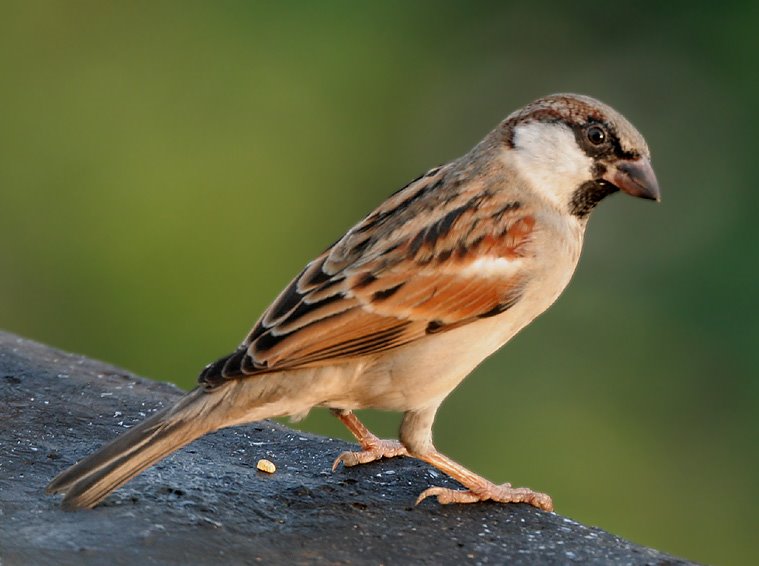
- What became of you, bright sparrow, featherhead?

poem by Michael Hofmann
republished with permission of the author
first published in The New Yorker
from Acrimony (Faber, 1986)


I've loved Hofmann's poetry since I first came across an old copy of what I still think his best collection, Acrimony, some years ago. Despite frequent comparisons to Robert Lowell, he strikes me as a remarkably original poet, something I tried to get at in this critical piece on his work. I'd agree with what A B Jackson once said on Rob Mackenzie's Surroundings too: that, simply and often brilliantly, with Hofmann's brand of 'plain style' poetry "you get a real sense of that definition of a poet as one who makes Good Choices, out of all the thousands of possible ones: [...] that knack of hitting the right nail."

'Changes', the poem published above, is from Acrimony, and is also included in Hofmann's Selected Poems, published by Faber last year and something I'd highly recommend to those not familiar with his work. In his review of the book on Tower Poetry, here's what poet-critic Simon Pomery had to say about the poem:

'Changes' is a portrait of a lady in the time of Thatcher, comparable to the fearless but hopeless Marlene of Caryl Churchill's Top Girls. It illustrates how the ideology of an age impacts upon the individual. Here is a tercet:

'Hard to take you in your new professional pride -
a salary, place of work, colleagues, corporate spirit -
your new femme d'affaires haircut, hard as nails.'

Satire leaks through the use of plosives. There is a latent invective spit in those clipped p's, the world of fast tracks and grad schemes, of 'corporate' 'colleagues', is exposed as worthless, the invective articulated through cussing c's. The phrase 'corporate spirit' draws attention to the genius below the surface of the quotidian: its Latinate prefix, 'cor-', means heart, 'corporate spirit' is oxymoronic, and the heartlessness of the beloved's Thatcherite uniform is exposed for what it is: on the surface she looks 'hard as nails', but beneath it her heart has shrunk to nothing. Hofmann's final lyrical query 'What became of you/ bright sparrow, featherhead?', laments the road taken to the office, to profit for its own sake.

A good reading of the poem I'd say - 'Changes' is one of my favourite Hofmann poems exactly because it so well exemplifies his ability to address something personal, emotional and detailed while also making deft social commentary and wider observations about the age. It's something he also does effectively in the many poems about his father, and in poems detailing foreign travel (particularly in a third book, Corona, Corona).

I'll also link, before I have to get on with some work, to this excellent new poem, 'Cricket', published in a recent(ish) issue of Chicago's Poetry magazine. "Did I say it was raining, and the forecast was for more rain? // Riveting. A way, at best, for the English / to read their newspapers out of doors, and get vaguely shirty / or hot under the collar about something." Spot on.

Recent Issues

Well, here are a few recent issues of magazines that I thought I'd flag up, and no, not just because I've something of my own included in them, which in several cases I don't, but because I've subscriptions to many poetry mags and journals for the simple reason that, in many ways, they're the lifeblood and engine rooms of new writing and, on this slightly gloomy looking Wednesday morning, I'd like to encourage you, dear Wasteland reader, to consider subscribing to a new publication today.

First off, the latest issue of New Welsh Review dropped with a satisfying thud through my letterbox the other week, and aside being excellently produced (nothing superficial about enjoying the look and feel of a stylish book or magazine with high production values, and to be honest, NWR holds its own against most books, never mind journals), it also contains plenty of engaging new writing, including two new poems from Samantha Wynne-Rhydderch, fiction from Nii Ayikwei Parkes, plus reviews of Philip Gross's T.S. Eliot prize-winning collection The Water Table, and a new collection of short stories inspired by the work of Jane Austen.

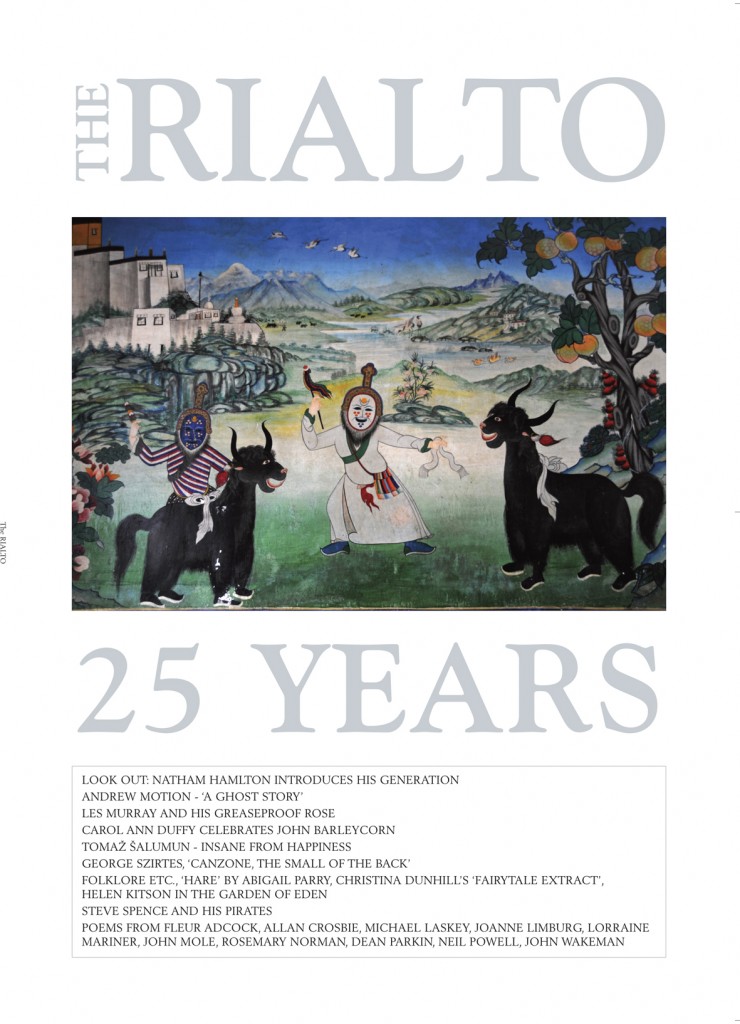
I'd also recommend the latest issue of The Rialto, celebrating 25 years of this major publication's appearances, and including - among new work from Carol Ann Duffy, Andrew Motion, Lorraine Mariner and Rachel Curzon - 'Look Out', the first part of a special feature on new poets under 35 edited by Nathan Hamilton, with poems from Andrew Jamison, Luke Kennard, Chris McCabe, Heather Phillipson, Keston Sutherland and Jack Underwood. Well worth a look.

The latest issue of Orbis, #150, is also packed with poems and reviews of recent books, and its usual 'Lines on Lines' section of candid reader comments on the previous issue. Where the poems in #150 are concerned, highlights for me came in the shape of Rupert Loydell's 'Paper Children', Eoghan Walls's 'Terminal One', and Todd Swift's 'The Port Daniel House'. Reviews include a round-up of recent pamphlets from the indefatigable Smith/Doorstop (the publishing house of the, now Sheffield-based, Poetry Business), including Sally Goldsmith's Singer, a short little book that packs an emotional yet unsentimental punch, and one which I'd recommend getting hold of.

Lastly, the latest issue of the Times Literary Supplement (No 5590, May 21 2010) contains the usual array of incisive, decisive, highly readable and thought-provoking literary reviews, not least a piece on Merrill Chleier's study of architecture and gender in American film, Skyscraper Cinema, and Michael Hofmann's translation of Gottfried Benn's poem, 'Englisches Café'. But I'd like to point you in particular towards the poetry reviews, not only because of pieces on new collections from Selima Hill and Antony Dunn, among others, but because there's a review of my own included of Sian Hughes's excellent debut, The Missing. It's a real shame that this book didn't come away with a prize or two, having been shortlisted for the Forward Prize for Best First Collection and chosen as a Poetry Book Society Recommendation. As I say in the review, the collection is a short one of, often, short poems: something that perhaps belies its exactitude, hard-won emotional truths, and long road to completion. At any rate, it really is a great debut collection, and one which I've returned to on several occasions recently. So I'll end by saying that, as well as subscribing to a poetry magazine today, you should really push the boat out and go and order The Missing, which you can pick up from Salt's website, here. And if you need any more convincing, you should first read this powerful and emotive elegy, 'The Send-Off', which won Hughes the Arvon International Poetry Competition a few years back. Moving isn't the word.

Sunday, 4 November 2012

Moon


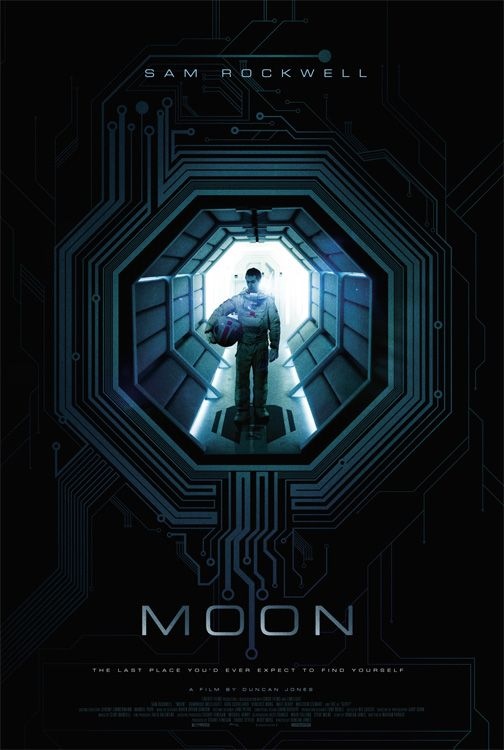
A few weeks ago I went to see Moon, the excellent debut film from director Duncan Jones (once known as 'Zowie Bowie') - an impressively eerie, cerebral and often darkly funny piece of sci-fi cinema that details the life of a man alone on the lunar surface. I highly recommend it, and briefly entertained thoughts of writing a lengthier piece about it here, but then a friend of mine has recently set up a film review blog, and has done an excellent job of writing an intelligent and incisive piece on the film. So I needn't bother waffling on - instead, you can read the review here. What's more, it doesn't completely give the game away unlike many reviews I've read of Moon, which means if you do decide to go and see it, this review won't ruin your experience of it.

Saturday, 3 November 2012

Elbow live with the BBC Concert Orchestra


A brilliant feature I spotted this morning on the BBC Radio 2 website: English alt-rock band Elbow perform the whole of their Mercury-prize winning album, The Seldom Seen Kid, augmented by the BBC Concert Orchestra (originally recorded and broadcast last Saturday).

For those who know the album, the songs are played in tracklist order, but for those who don't and aren't particularly familiar with the band, I'd suggest checking out 'The Fix', performed with local Sheffield singer-songwriter Richard Hawley (around the 36min mark) and the anthemic 'Day Like This' (around the 47min mark).

An absolutely brilliant performance, it can be found here.

And as a sampler, since it won't let me embed the video of the whole performance, above is the recording of thumping single, 'Grounds for Divorce'.

Friday, 2 November 2012

An Artist of the Floating World

In his collection of essays Music at Night, Aldous Huxley famously remarked that "after silence, that which comes nearest to expressing the inexpressible is music". The idea is by no means a new one: where words fall short, music can often seem uniquely placed to articulate our subtlest moods, thoughts and emotions. Yet few can have explored this concept, or its wider complexities, with the delicacy and originality of thought that Katharine Towers achieves in this ambitious, powerful and memorable debut, longlisted for the Guardian first book award.

In their deft harnessing of the music intrinsic to language – that which fuels poetry's thrilling confusion of sense with sound – Towers's poems are akin to those moments of quiet clarity amid the bustle and blur of daily life. The book's opening poem, "Amber", is a terse vignette that sets the tone with an elegant metaphor: figured as a frail "thought" and, by extension, a stay against confusion, the resin's safeguarding qualities make it a talisman "to hold against the slipshod years".

The Floating Man contains many such "flies in amber". On "Camusdarach Beach", a seal raises its "orphan eyes" to two lovers, "sensing our lives on the turn", while in "Trust", a memory of the poet's young daughter swimming in the sea is conjured from the complex, maternal emotions with which it is tangled. Even half-forgotten words are made strangely tangible in "Found": "old stones we've wintered in the earth / to learn the darkness underneath".

Yet there is nothing showy about these poems. Succinct and unassuming, they rarely draw on the full orchestra of effects at the poet's disposal, instead favouring subtle, single notes. "The Dread", for example, is an unsentimental view of arctic terns, birds that "have no weight but heart-weight", "no thinking, but know the curve and swing / of the earth". Through gentle assonance, the poem develops a studied coolness, anticipating the sudden silence – known as the Dread – before the birds jointly take flight: "as if / someone quietly said: come, follow me." That calmness, the poem suggests, is almost a shadowy memory in the terns' collective mind; a moment's eerie stillness that jolts them again into restlessness. The poem succeeds in expressing this notion and its human resonance, while avoiding the naïve anthropomorphism that would undermine such observations. It's a neat trick which Towers pulls off elsewhere, most notably in "Haunts", a concise unpicking of the fragile divide between the natural and the human worlds:

We can walk into woods and find
we are suddenly mortal.
The air has kept still for seasons
and we've no cause to speak

or to question this adequate moment
of moths, earth, light restrained by trees.
Let us not think we hear our own feet
treading the soft ash of leaves.

Nature offers a brief reprieve from the human labyrinth; opportunity to escape a world where everything appears in the guise of its value or function. But even if we stop questioning such "adequate" moments in order to pursue a broader understanding, we soon return to centring the scene on ourselves, however ghostly a presence we might be. How can we help but hear, in the sly sibilance of that final line, "our own feet / treading the soft ash of leaves"?

The book's presiding spirit – "The Floating Man" of the title poem – offers an answer of sorts. Enacting a thought experiment devised by the Persian polymath Ibn-Sina, an attempt to prove the independence of the soul from the physical body, our narrator imagines himself suspended, isolated from all sensory experience, "for as long as it takes to forget the sweating desert / and the sifting streets of Hamadan." In doing so, he approaches a kind of objectivity, blurring the false distinctions we observe: "Shall I say I am a man or a thought, / or a man thinking about deserts and cities?"

This expansive attention to detail, the ability to look beyond one's own narrow perspective, enriches Towers's writing and her search for emotional truths. Some of these poems are sensitive as a cardiograph to the moments they chart: "She's there on a branch: don't startle her" warns the poet in "Nightbird". Similarly, while waiting to hear their "late evening / call to prayer" in "In the Oak Woods", the narrator is "quiet for fear the owls might startle / and fly from their rooms".

The best poems in The Floating Man, however, are those which express human relationships in terms of music and vice versa, augmenting our understanding of both. "The Art of Fugue" opens with the hopefulness inherent to the form: a contrapuntal composition of conversing "voices" which the poem imbues with human characteristics; "solemn instruments, which yawn / and clamber to their feet" and "suppose they feel the same". Yet this simplicity, "the clean white sail of a tune making everything good", isn't quite as it seems: the desire to bring things to a close, each instrument "using their own words", is never far away. In love as in music, harmony is unstable, fleeting, and often appears as artifice: by the end of "Counterpoint", the poem's warring couple settle for a truce; "you still banging away at the deep end, / me somewhere up in the gods, trying the high notes".

It's these intelligent and honest insights, always intent on offering a fresh outlook, that lend Towers's quiet poems their tenacity; testament to her inclination, as with "The Language Spider" in one poem, "to favour stealth / over the grand gesture".


first published in The Guardian, Saturday 11 September 2010

Thursday, 1 November 2012

Genie 34299R Intellicode Wall Console


Features
  • GENIE INTELLICODE SERIES II WALL CONTROL 34299R
  • For GENIE Intellicode garage door openers only.
  • (Look for Intellicode on side of motor head to know if this will work with your unit)

List Price:
Get this month Special Offer: check this out!

Related Products

Product Description
For GENIE Intellicode garage door openers. These openers are also refered to as Series II garage door openers, which refers to all Genie Intellicode (rolling code) garage door opener systems. One button for light only; one button to operate door and light time delay; vacation switch to shut system down.


Wall Consoles Wall Consoles If you don't see the part you're looking for or have technical questions, please email us or give us a call. Having trouble finding the right Genie ... Genie Garage Door Openers, Genie Garage Intellicode, Genie Garage ... OverHead Door Garage Door Openers: Garage Door Opener Parts and Accessories: Genie, Genie Intellicode, Excelerator, Alliance, AlliancePro, BlueMax ... Genie, Series II Wall Control 34299R, Remote Control - Amazon.com 3 Function wall console. For use with Genie intellicode openers. Security button and independent light button. For use inside the garage. Product Details Shipping ... Genie Garage Door Opener Replacement Parts, Universal Intellicode ... We carry a full line of Genie, Genie Intellicode (Alliance, AlliancePro, BlueMax, Lift-A-Door, OverHead Door, ProMax, Hercules, GeniePro, GMI, Norelco, Stealth ... genie intellicode remote eBay - Electronics, Cars, Fashion ... Find great deals on eBay for genie intellicode remote and genie remote. Shop with confidence. Garage Door Opener, Hercules: genie, craftsman garage door opener ... Deluxe Wall Console for Genie Intellicode Garage Door Openers Series II ONLY. 3 function console operates opener, controls lights and security ... GPWC-BX Genie Wall Console 34299R - Replacement Garage Door Parts ... This car garage door opener operates from inside the garage and saves energy with its independent light control. The GPWC-BX Genie deluxe wall station is a genuine ... Genie 34299R Intellicode Wall Console - Amazon.com For GENIE Intellicode garage door openers. These openers are also refered to as Series II garage door openers, which refers to all Genie Intellicode (rolling code ...